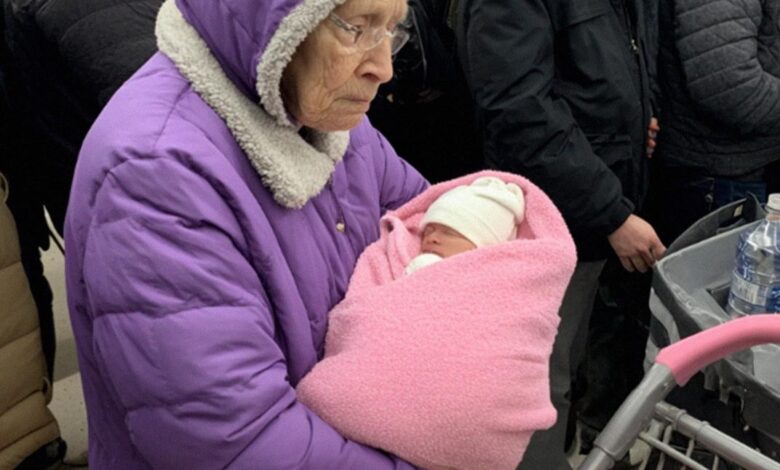
I’m Margaret—72 years old, widowed, and learning how to raise a baby all over again after life knocked the wind out of me. Six months ago, my daughter Sarah walked out the frontand never came back. She left her newborn, Lily, sleeping in a bassinet by the window, wrapped in the same yellow blanket I’d brought Sarah home in. She kissed her daughter’s forehead, told me she needed fresh air, and disappeared into the cold morning.
I spent that first night pacing the living room, checking Lily’s breathing every hour, convinced Sarah would come back through the door, apologizing, explaining. Instead, all I found was a folded note beside the coffeepot the next morning: Mom, I can’t do this. Don’t try to find me.
The police said they couldn’t help. The father blocked me after one cold phone call. And just like that, I became a mother again at 72—with no roadmap, no partner, and barely enough money to make ends meet.
Raising a baby at my age is both beautiful and brutal. Lily is a light, a warm, tiny heartbeat against my chest when I rock her at 3 a.m. But she’s also diapers, formula, doctor’s visits, and bills that seem to grow no matter how carefully I budget. Some days I stretch soup across two nights so I can afford her next pack of diapers. I’ve learned which stores put formula on sale and exactly how long I can go before calling the electric company to ask for an extension.
That day—the day everything changed—I was already exhausted before noon. The kitchen faucet had started leaking again, the washing machine groaned like it was dying, and Lily had fussed nonstop. When I realized we were out of diapers and baby food, I bundled her into her carrier and braced myself against the biting November wind.
The store was chaos: holiday music blasting, carts bumping into each other, shoppers arguing over turkeys. I moved fast, grabbing baby food jars, a small pack of diapers, and one tiny portion of turkey breast so Lily and I could pretend to have a Thanksgiving dinner.
At the register, I prayed my card would go through. I slid it once.
Declined.
My throat tightened. I tried again. Same beep. Same denial.
Behind me, someone groaned. “Oh great. Here we go.”
Another voice chimed in: “What is this, a charity line?”
Lily began to cry, her small wails echoing my own rising panic. I bounced her gently, trying to soothe her while digging through my purse for cash. All I found were eight crumpled dollars.
A woman further back snorted. “Maybe don’t have kids you can’t afford.”
Her friend added, “People like this make me sick.”
My face burned with humiliation. I had never felt so small, so powerless. I whispered to the cashier, “Just the baby food, please,” my voice barely more than a breath.
Then a calm voice behind me said, “Ma’am. You—with the baby.”
I turned slowly, bracing for more cruelty.
Instead, I saw a man—mid-thirties, in a black coat—looking at me with quiet gentleness. He stepped forward and said to the cashier, “Cancel her order. Ring everything up again.”
Before I could protest, he tapped his card to the reader. Approved.
People in line muttered, rolling their eyes, scoffing. One man barked, “What, are you paying for all of us too?”
he stranger turned to them, standing taller. “It’s sad,” he said evenly. “You watched an elderly woman struggle to buy baby food—and you mocked her. If that were your mother, would you still find it funny?”
Silence washed over the line. For the first time all day, I felt the sting of humiliation fade, replaced by something warmer—dignity.
When I tried to thank him, the words barely came out. He shook his head. “Just take care of your little one,” he said softly. “That’s all.”
Outside, as he carried my bags to his he shared that his own mother had passed away two months earlier. “You remind me of her,” he said quietly. “Let me help. It would mean something to me.”
When he offered me a ride home, I hesitated. But my legs were aching, the bus was far, and the cold cut through my coat like knives. He had a car seat already in his backseat. He buckled Lily in with practiced ease.
During the drive, he told me he had two children of his own. I told him about Sarah leaving, about stretching every dollar, about losing sleep and trying to stay strong. He listened—really listened.
By the time we reached my building, I felt lighter. He carried my groceries upstairs and wished me well.
I assumed that was the end.
The next afternoon, my doorbell rang. Standing there was the man—Michael—his wife, and their two children. He held a warm pie. His wife held a folder.
“We’d like you and Lily to join us for Thanksgiving tomorrow,” she said gently. “And these”—she handed me the folder—“are profiles of nannies. Good ones. If you’re open to it, we’d love to help.”
I felt tears spill before I could stop them.
Thanksgiving at their home was like stepping into a different world: laughter, warmth, family. They didn’t look at me as a burden. They looked at me as someone worth helping.
A few days later, with their encouragement, I accepted their offer to hire a nanny. Patricia arrived the next week—steady, kind, and wonderful with Lily. For the first time since Sarah left, I slept through the night.
Michael and his family didn’t fade away. They became the kind of people you thank God for—the kind who step into your life at the exact moment you’re about to crumble.
Every Thanksgiving now, I bring them a homemade pie, the same kind he handed me that first day. And every year, I whisper a quiet prayer of gratitude for the moment my card declined—because that humiliating moment opened the to kindness I never expected and a family I never knew I needed.
