Donald Trump says he is giving US troops warrior dividends for Christmas!
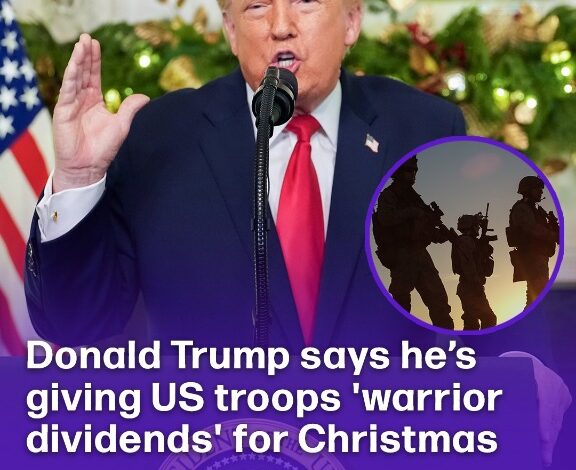
In a move that combines historical symbolism with significant fiscal policy maneuvers, President Donald Trump has announced the implementation of a “warrior dividend” for United States military personnel.1Delivering a televised address from the White House on December 17, 2025, the President detailed a one-time payment of $1,776 designated for every active-duty and reserve service member.2 The specific figure is a deliberate homage to the nation’s founding year, designed to reinforce a narrative of American exceptionalism and national security strength. As the administration pushes this initiative as a festive “Christmas gift,” the move has ignited a broader discussion regarding federal budget allocations, the economic impact of trade tariffs, and the strategic management of military compensation and benefits.
The logistics of this massive undertaking involve the distribution of approximately $2.57 billion in federal funds. According to senior administration officials, Defense Secretary Pete Hegseth has directed the Pentagon to process these payments through the existing Basic Allowance for Housing (BAH)framework. By designating the dividend as a housing allowance supplement, the administration ensures a streamlined delivery process, bypassing the typical legislative hurdles associated with a standalone stimulus package. This tactical use of defense appropriations is aimed at providing immediate financial liquidity to approximately 1.28 million active-duty troops and 174,000 members of the Selected Reserve.
From a macroeconomic perspective, the funding of the warrior dividend draws upon a controversial mix of revenue streams. The President asserted that the program is partially financed through the proceeds of aggressive import tariffs and the ongoing dividends of the Republican-led tax reform initiatives.3 This approach reflects a broader economic developmentstrategy that seeks to redistribute trade revenue directly into the hands of a specific domestic demographic. For experts in wealth management and tax planning, the injection of $1,776 into over a million households represents a localized surge in consumer spending power, which the White House hopes will act as a secondary stimulus for the domestic economy during the holiday quarter.
The President’s address was not limited to the logistics of the payment; it served as a platform for a sharp critique of previous government spending priorities. Trump accused prior administrations of prioritizing foreign aid and international interests over the welfare of domestic “warriors.” By framing the dividend as a corrective measure, the administration is leaning heavily into a “America First” public relations strategy. This positioning is particularly critical given the current political climate, as the President seeks to solidify his base within the defense and aerospace sectors while addressing concerns regarding the rising cost of livingfor military families.
However, the announcement arrives at a time of significant market volatility and shifting public sentiment. Recent public opinion polling data from Reuters/Ipsos suggests a complex reception for the President’s economic agenda. His economic approval rating recently dipped to a new low of 33 percent, with an overall approval rating of 39 percent. For political risk analysts, the warrior dividend is viewed as a high-stakes attempt at reputation management, aimed at reversing these trends by delivering a tangible, “bankable” win for a highly respected segment of the population. The efficacy of this brand positioning will likely depend on whether the $1,776 payment is perceived as a genuine commitment to human capital investment or a temporary distraction from broader inflationary pressures.
The Defense Department’s role in this distribution is equally noteworthy. By utilizing the housing allowance supplement model, the Pentagon is addressing a chronic issue in military family advocacy: the widening gap between service pay and the soaring real estate prices in many garrison towns. In regions with high cost-of-living indices, such as San Diego or Northern Virginia, a $1,776 supplement offers meaningful, albeit temporary, relief for those struggling with mortgage interest rates and rising rents. This focus on “quality of life” metrics is a key component of the administration’s human resources management strategy, aimed at bolstering retention rates and recruitment within the all-volunteer force.
Critically, the timing of the “warrior dividend” ensures that the checks are slated to arrive by Christmas Day, 2025. This creates an immediate experiential marketing effect, associating the administration’s fiscal leadership with the emotional peak of the holiday season. While critics argue that the initiative is an unconventional use of executive authority over the defense budget, supporters point to it as an innovative form of corporate social responsibility on a national scale. The debate over the legality and long-term sustainability of the national debt remains, but for the individual service member, the focus remains on the immediate influx of disposable income.
The “1776” branding also serves a dual purpose in strategic communications. By anchoring the payment in a historical milestone, the administration taps into the lucrative market of patriotic consumerism. It transforms a standard government disbursement into a symbolic gesture of national pride. For the digital media and news cycle, this creates a compelling narrative that is easily digestible and highly shareable across social media networks. This synergy between populist policy and digital content strategy has been a hallmark of the Trump administration’s approach to governance, effectively bypassing traditional media gatekeepers to speak directly to the “warrior” class.
As the checks begin to clear through the Federal Reserve system, the long-term investment outlook for this policy remains under scrutiny by economists and policy analysts. Some argue that the $2.57 billion could have been more effectively utilized for defense technology innovation or long-term VA healthcare infrastructure. Others contend that the direct-to-consumer nature of the dividend is the most efficient way to combat the “boots on the ground” reality of economic hardship. The resolution of this debate will likely play a significant role in shaping the legislative agenda for 2026, as both parties prepare for the next cycle of election year politics.
In the final analysis, the warrior dividend represents a significant moment in the history of American military compensation. It is a bold experiment in monetary policy that tests the limits of executive power and the resilience of supply-side economics. Whether it succeeds in its goal of improving the “quality of life” for 1.45 million service members or simply serves as a temporary reprieve in a challenging economic landscape, its impact is undeniable. As the nation prepares to celebrate the holiday, the sight of a $1,776 “warrior dividend” in a bank account serves as a potent reminder of the intersection between patriotism, politics, and the pocketbook. It is a legacy-defining move that ensures the 2025 holiday season will be remembered as one where the founder’s vision met modern financial engineering.
