The Meaning Behind the Small Fish Symbol Seen on Some Cars!
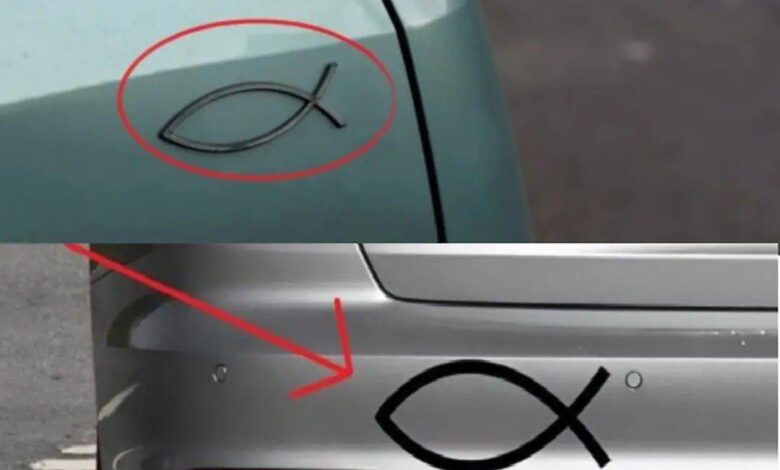
You may have noticed it while sitting at a red light, inching forward in traffic, or pulling into a parking lot: a small fish-shaped emblem affixed to the back of a car. It is usually understated—metallic or plastic, minimalist in design, never flashy. Yet despite its simplicity, it consistently draws attention and curiosity. Many drivers wonder whether it is merely decorative or if it carries a deeper meaning. The answer lies in a long cultural and historical tradition that reaches far beyond modern vehicles, bumper stickers, or personal branding.
The fish symbol is far older than the automobile. Long before highways, traffic laws, or commuter culture existed, this emblem served as a quiet marker of shared belief and values. Its origins trace back centuries, when symbols were often used as discreet forms of identification in times when open expression could be risky or unwelcome. The fish was chosen not for grandeur or dominance, but for its simplicity and humility. It communicated belonging without confrontation and conviction without spectacle.
Historically, the fish symbol became associated with core virtues such as patience, humility, compassion, and respect for others. Unlike symbols designed to project power or authority, the fish conveyed something internal and personal. It was never meant to persuade or provoke. Instead, it functioned as a subtle signal of character—an outward reflection of inward values. Those who recognized it understood its meaning, while others simply passed by without disruption. That quiet restraint is central to why the symbol has endured.
In the modern era, the fish has found renewed relevance in an unlikely place: the back of cars. As daily life has grown faster, louder, and more congested, many people seek ways to ground themselves amid constant stimulation. Driving, in particular, has become a pressure-filled experience. Traffic congestion, aggressive driving, distracted motorists, and time constraints turn roadways into stress zones. Against this backdrop, the small fish emblem has taken on a new, practical role.
For many drivers, displaying the fish is not about making a public statement or asserting identity. It is a personal reminder. A cue to slow down, to stay calm, and to treat other drivers with patience—even when circumstances invite frustration. In this sense, the fish symbol acts almost like a behavioral anchor. It reinforces mindful driving habits, encourages emotional regulation behind the wheel, and promotes safer, more courteous interactions on the road.
Importantly, the symbol does not claim moral superiority, special privilege, or protection. It does not ask for deference or demand agreement. Its power lies precisely in what it does not do. It does not shout. It does not compete for attention. In an environment saturated with bold decals, political slogans, and aggressive messaging, the fish stands apart by being deliberately restrained. That restraint resonates with people seeking balance in an overstimulated world.
The fish emblem has also become a subtle form of personal expression. Modern vehicles are mass-produced, often indistinguishable from one another. Small details—license plate frames, color choices, and modest symbols—allow drivers to express individuality without dominating shared space. The fish accomplishes this quietly. It humanizes the vehicle, suggesting that behind the wheel is a person guided by reflection rather than impulse.
From a psychological perspective, symbols like this can influence behavior more effectively than rules alone. Visual reminders are powerful, especially when tied to personal values. Seeing the fish each time one approaches the car or checks the rearview mirror can reinforce intentional behavior. It becomes a silent agreement between the driver and themselves: to choose patience over aggression, awareness over reaction.
This is one reason the fish symbol continues to generate interest across high-value search topics such as symbolic meaning in everyday life, mindful driving practices, personal values in modern culture, and nonverbal communication symbols. Its relevance is not confined to any one belief system or demographic. Instead, it speaks to a broader desire for calm, courtesy, and ethical conduct in shared environments.
There is also an important social dimension to the symbol. Roads are communal spaces. Every driver, regardless of background or destination, participates in a collective system that only functions when mutual respect exists. The fish serves as a quiet acknowledgment of that shared responsibility. It reminds us that transportation is not just a mechanical process, but a human one—where empathy and restraint can have real-world consequences.
Over time, the meaning of the fish has evolved without losing its core. While its historical roots remain significant, its modern interpretation is flexible and personal. Some see it as a reflection of faith, others as a commitment to kindness, and still others as a reminder to slow down in a fast-paced world. That adaptability has allowed the symbol to persist across generations, cultures, and contexts.
In a society increasingly defined by noise, speed, and polarization, the continued presence of such a modest emblem is notable. It suggests that not all communication needs to be loud to be effective. Not all identity needs to be broadcast. Sometimes, the most enduring messages are the ones that quietly influence how we behave when no one is watching.
Ultimately, the small fish symbol on a car is less about what others see and more about what the driver remembers. It is a private commitment made public only in the most understated way. A reminder that the road is shared, that patience has value, and that everyday actions—especially the small ones—shape the tone of our collective experience.
